Choose the right Recycle Check
This guide helps you get started in just a few steps.
With the introduction of the PPWR, Europe is working towards a single, harmonized system for assessing packaging recyclability. Consequently, Verpact has adjusted the role of the Recycle Checks. From 2027 onwards, Recycle Checks will be available only for rigid and flexible plastic packaging.
You can use these Recycle Checks to substantiate fee differentiation for plastic packaging. This means you may be eligible for a discount on your waste management fee if the packaging proves to be highly recyclable.
We will no longer publish new Recycle Checks for glass, metal, paper and cardboard, or beverage cartons starting in 2027; we are awaiting clarity from Europe. We are actively contributing the knowledge we have built - and continue to build - to European discussions. Once there is greater clarity from Europe, we will offer support aligned with those developments. We ensure that our tools always comply with the latest European legislation and regulations.
Previously published Recycle Checks remain available as background information for the sake of transparency. PLEASE NOTE: Recycle Checks are valid only for the year to which they apply and may not reflect the state of technology in other years. Therefore, do not use an older Recycle Check to assess the recyclability of packaging in 2027. Recycle Checks from previous years remain available for transparency purposes.
The 2027 Recycle Checks are designed to assess the recyclability of plastic packaging as defined under European legislation (PPWR) (Step 1). Many packages consist of multiple parts or materials that are discarded separately. Therefore, you first break the packaging down into disposable units (Steps 2 and 3). Next, for each disposable unit, you identify a main component and any sub-components (Step 4). You can then assess recyclability based on this information.
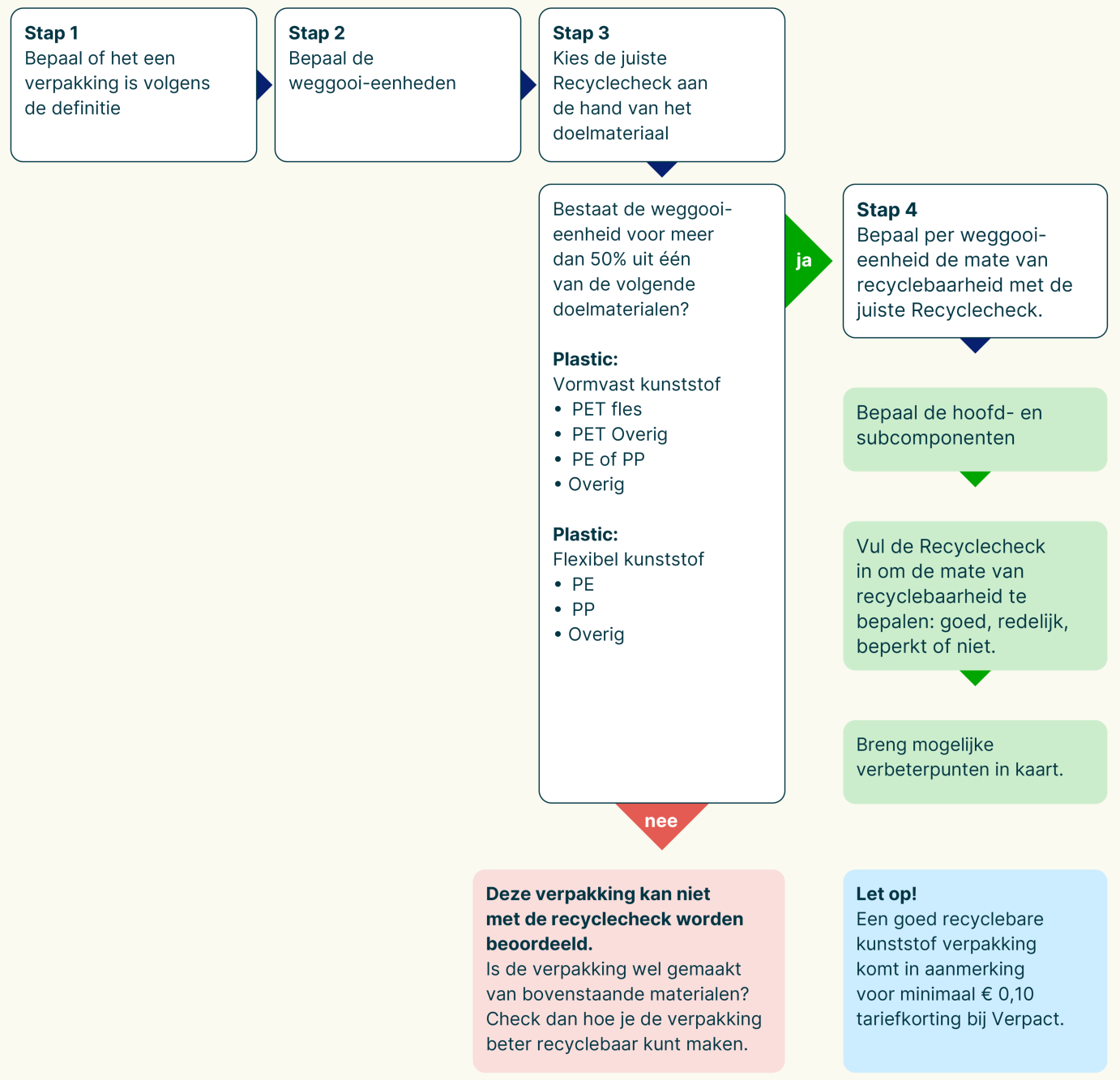
Please note: from 2027 onwards, Recyclechecks will only be available for rigid and flexible plastic packaging.
You need the Recyclechecks if you wish to apply for a discount on highly recyclable plastic packaging through fee differentiation. Below, we outline the steps for selecting the correct Recyclecheck.
Step 1. Determine whether it is packaging
The Recyclechecks only provide reliable results for assessing packaging. Therefore, first verify whether the item you wish to assess meets the definition of packaging. From now on (Recyclecheck 2027), Verpact applies the PPWR definition of packaging:
Packaging: "Item intended for the containment, protection, handling, delivery, or presentation of products to another economic operator or to an end-user."
If you are unsure whether an item constitutes packaging, please consult the (non-exhaustive) Packaging Catalogue on the Verpact website.
The Recyclechecks apply only to plastic packaging.
Step 2. Determine the disposable unit(s)
Do you discard the packaging in its entirety after use? If so, it constitutes a single disposable unit. If you do not discard the packaging as a whole but rather in separate, loose components, it consists of multiple disposable units.
When assessing recyclability, it makes a significant difference whether various components or materials go through the sorting and recycling process together or are processed as separate units. In practice, it is common for some disposable units of a single package to be highly recyclable, while others are only moderately or limitedly recyclable.
Verpact operates on the premise that every package consists of a single disposable unit, unless:
The packaging consists of separate components that are not attached to one another.
You must permanently and completely remove a component of the packaging in order to use the product.
The packaging contains components—such as a snap-on lid—that detach under minor mechanical stress.
Detachment of components
You must demonstrate that detachment occurs under minor mechanical stress. Demonstrating this using laboratory-prepared samples is insufficient; the assessment must be reproducible using packaging filled during at least three different production runs. Simple test for lid film detachment
To determine whether a lid film detaches under slight mechanical stress, grasp the opened, empty package by the lid film and shake it. If the film detaches easily, it constitutes a separate disposable unit. At the start of the test, the film must be attached across at least one-quarter of the seal area.
Simple test for snap-on lid detachment
To determine whether a snap-on lid detaches under slight mechanical stress, squeeze the empty package with the lid attached. If the lid pops off completely, it constitutes a separate disposable unit.
Test for sleeve detachment
Some packages feature a sleeve that detaches completely when the package is compressed—for example, plastic cups with a cardboard sleeve featuring a perforation that breaks upon compression. The Compression Protocol allows you to demonstrate whether the cup and sleeve separate and act as independent disposable units. You can find this protocol on the protocols page.
Cardboard sleeve
Is there a cardboard sleeve around a plastic package that the consumer does not remove, but which you have demonstrated detaches during collection and sorting? In that case, the sleeve and the package behave as separate disposable units. Bear in mind that the cardboard sleeve will end up in the wrong sorting stream in this scenario, and that you should classify it as non-recyclable.
Step 3. Categorize the disposable unit(s)
For the Recyclecheck, you complete an individual checklist for each disposable unit. For each unit, determine the predominant overarching material type and—if applicable—the specific material type (see the list below) to categorize the unit. The category is determined by the material type that accounts for at least 50 percent of the unit's weight. This is referred to as the target material.
If no single material type accounts for more than 50 percent, you cannot assess the disposable unit using the Recyclecheck. In that case, modify the packaging. The material types for which Verpact has developed Recyclechecks:
- Rigid plastic
- PET bottle
- PET other (e.g., PET trays)
- PE/PP
- Other rigid plastic
- Flexible plastic
- PE
- PP
- Other flexible plastic
You use these Recyclechecks to substantiate fee reductions for plastic packaging.
Previously published Recyclechecks
In previous years, in addition to Recyclechecks for plastics, Verpact also published Recyclechecks for: metal (steel and aluminium), glass, paper and cardboard, and beverage cartons.
We will no longer publish new Recyclechecks for these materials starting in 2027; we are awaiting clarity from Europe. We are actively contributing the knowledge we have built up - and continue to build - to European discussions. Once there is greater clarity from Europe in the near future, we will offer corresponding support. We ensure that our tools always align with the latest European laws and regulations.
PLEASE NOTE: The Recycle Checks apply only to the specific year for which they are intended; this is clearly stated in both the tool and the background documents.
Step 4. Determine the level of recyclability
Identify the main component and any sub-components of the disposable unit. The main component is the part that contains the product and usually accounts for the largest share of the weight.
Sub-components are parts attached to the main component, such as labels, sleeves, caps, or closures. These parts go through the sorting and recycling process together with the main component, thereby influencing the recyclability of the packaging.