Recyclecheck updatet
From 2027 onwards, the Recyclecheck will be available exclusively for rigid and flexible plastic packaging. We have modified the Recyclecheck in several respects. In doing so, we are gradually aligning the methodology with future European requirements - specifically, the PPWR (Packaging and Packaging Waste Regulation). At the same time, the Recyclecheck remains a practical tool for designers, manufacturers, and those responsible for packaging.
PLEASE NOTE: Recyclechecks apply only to the year for which they were issued and may not reflect the state of technology in other years. Therefore, do not use an older Recyclecheck to assess the recyclability of packaging in 2027.
For the sake of transparency, Recyclechecks from previous years remain available.
1. Revised definition of recyclability
From 2027 onwards, the Plastic Packaging Recyclecheck will be based on the definition of recyclability set out in the PPWR. A key consequence of this is that we are temporarily excluding the "industrial-scale recycling" criterion from our assessment, as this specific aspect of the PPWR does not come into effect until 2035. As a result, some packaging may receive a higher score than before—for instance, if it is technically highly recyclable but not yet recycled on a large scale.
2. New colors for clearer assessment
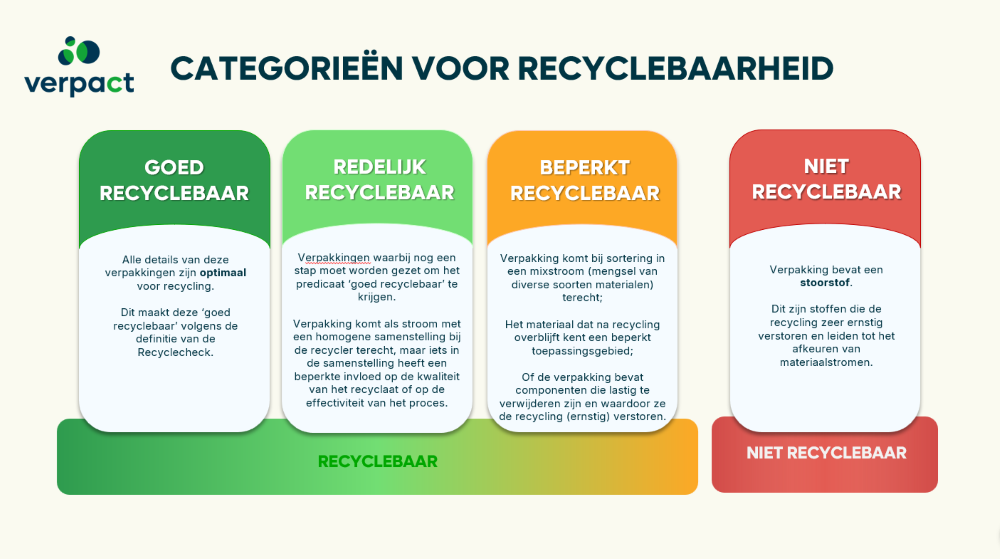
User feedback indicates that it is not always clear that the scores "Highly recyclable," "Reasonably recyclable," and "Limited recyclability" all signify that the packaging is indeed recyclable. We are therefore adjusting the colors:
- Highly recyclable: dark green
- Reasonably recyclable: light green
- Limited recyclability: orange
- Not recyclable: red
This allows you to see at a glance which packaging is recyclable.
3. PFAS
A tip has been added to the checklist to alert you to the negative impact of PFAS and the stricter legislation under the PPWR regarding this issue.
4. New material streams
The PPWR distinguishes between more material categories than the current Recycle Checks, as the Recycle Check only takes into account existing (rather than theoretically possible) sorting streams. We add material categories to the Plastics Recycle Check as soon as a clear Dutch sorting and recycling stream exists for that material.
5. Material-specific changes
Rigid Plastics
The most significant change is the addition of several substances that—when present in the main component, labels, closures, or sub-components—can lead to the formation of harmful substances such as benzene, formaldehyde, and BPA. These have a major impact on recyclability, particularly in the case of PET packaging.
Flexible Plastics
The key change is that flexible polypropylene (PP) plastic will be eligible for a "Highly recyclable" final score starting in 2027. Previously, "Reasonably recyclable" was the highest achievable score. This is because we are temporarily excluding the "industrial-scale recycling" criterion from the Recycle Check definition.
Other changes for flexible plastics
SiOx/AlOx barriers can now achieve an "Optimal" score in the questionnaire, provided they do not contain additional coatings. In this way, they have a negligible impact on recycling. This aligns with Recyclass’s Design for Recycling guidelines. EVOH can now achieve an ‘Optimal’ score in the questionnaire if a compatibilizer (PE-g-MAH) has been applied correctly or if there is a positive recycling test report. In this way, they have a negligible impact on recycling. This aligns with Recyclass’s Design for Recycling guidelines.
Request access to the recycling check
Want to know more? Consult the explanatory notes for the recycling check or contact Verpact.