Our results 2025
By recycling and reusing packaging as much as possible, we preserve valuable raw materials. We turn used packaging back into raw materials for new packaging and other products. In doing so, we contribute to a strong economy for the future. At the same time, we reduce our dependence on new raw materials and supplies from abroad.
2025 Annual Report
On behalf of packaging producers and importers, we are responsible for achieving statutory targets as efficiently and effectively as possible. We announce the results annually in the 2025 Annual Report. We also publish the monitoring report - a technical report addressed to the government containing all detailed information.
Recycling and circularity targets
Annual recycling targets apply to packaging based on material type. In 2021, the Dutch government also introduced so-called circularity targets, which allow packaging reuse to be included in the calculations. The Netherlands is one of the few countries in Europe with circularity targets. With this, the Netherlands is taking a significant step towards a circular economy for packaging.
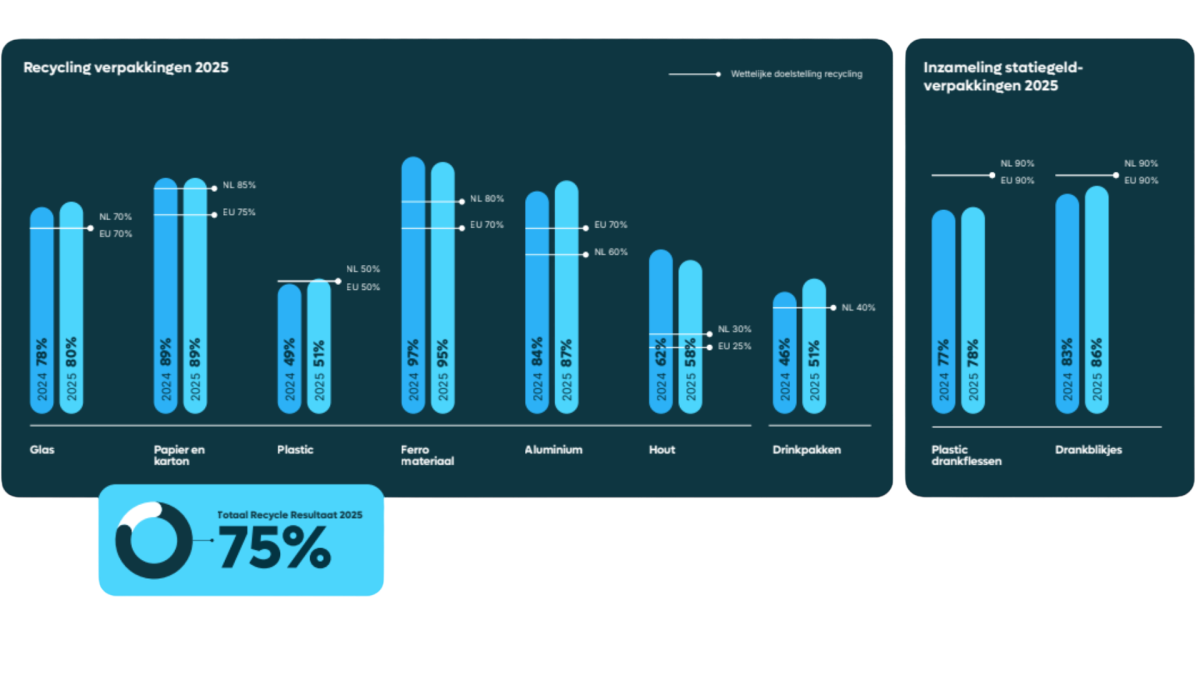
Recycling and circularity targets
Annual recycling targets apply to packaging based on material type. In 2021, the Dutch government also introduced so-called circularity targets, which allow packaging reuse to be included in the calculations. The Netherlands is one of the few countries in Europe to have circularity targets. With this, the Netherlands is taking a significant step towards a circular economy for packaging.
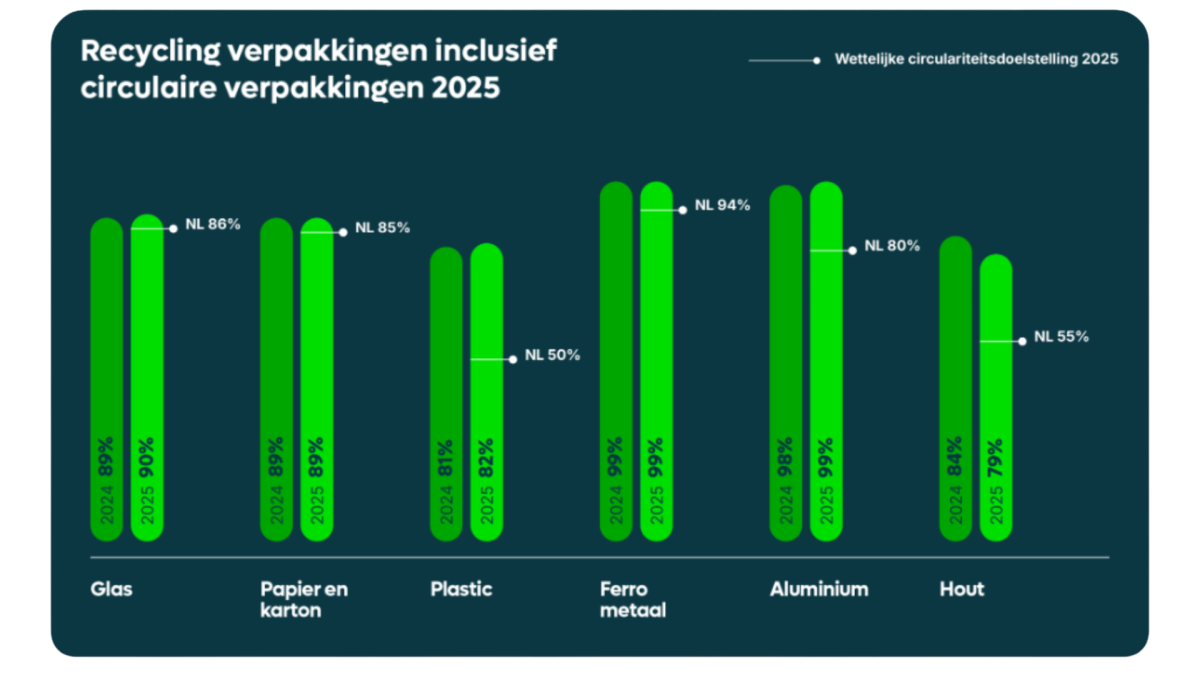
Circularity Results 2025
In 2025, 88% of all packaging placed on the market was circular - meaning it was either reused or recycled. This performance means the Netherlands comfortably meets statutory targets and ranks among Europe’s frontrunners.
This result stems from collaboration across the entire packaging value chain. Producers, importers, municipalities, waste management companies, recyclers, and consumers all contribute to this effort on a daily basis. The packaging industry is taking responsibility for this, a role we at Verpact execute collectively. At the same time, there is still work to be done. Further steps are required to achieve fully circular and fossil-free packaging by 2050. That is why we are collaborating with all parties in the chain to increase reuse, high-quality recycling, and the use of recycled raw materials.

Accelerating together towards a circular packaging value chain
This result stems from collaboration across the entire packaging value chain. Producers, importers, municipalities, waste management companies, recyclers, and consumers all contribute to this on a daily basis. The packaging industry is taking responsibility for this, a role we at Verpact fulfill collectively. At the same time, there is still work to be done. Further steps are required to achieve fully circular and fossil-free packaging by 2050. That is why we are working with all parties in the chain to increase reuse, high-quality recycling, and the use of recycled raw materials.
Results by material stream
Packaging consists of various materials, such as plastic, paper and cardboard, glass, wood, and metal. Each material involves its own specific collection, sorting, and recycling processes. On this page, you will find the 2025 results for each material stream, including figures on recycling, circularity, and the processing of packaging waste. This provides insight into performance by material and the contribution to a circular packaging value chain.
View all previous annual reports
You can find past annual reports and monitoring reports on the Annual Report and Monitoring Report overview page.